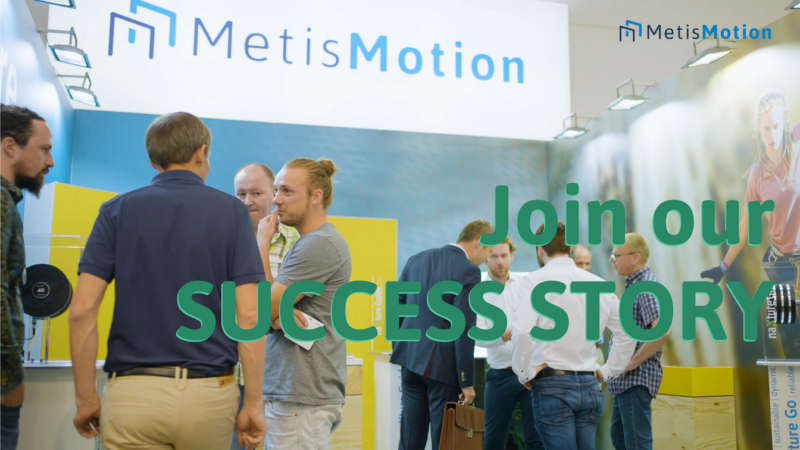
Giving AI “the human touch” – MetisMotion @ automatica 2025
At this year’s automatica in Munich, MetisMotion asked a question that stopped visitors in their tracks:
“What if an actuator could be the AI’s hand in the real world?”
The answer might just change how we think about robotics forever.
It’s a simple question with huge implications – because in robotics, the hand is far more than just a tool.
It’s the bridge between digital intelligence and the physical world, the point where algorithms meet reality. And right now, that bridge is fragile.
Today’s conventional electric drives excel in strength, precision, or adaptability – but rarely all three at once. This trade-off limits how robots can interact with their environment. They may be powerful but clumsy, or precise but fragile, making truly human-like dexterity impossible. Until we overcome this limitation, robots that move and react like humans will remain out of reach.

Humanoid robotics demands another leap. Human motion depends on multiple muscles working together in coordinated, distributed ways – 640 of them. Each contributing to fine control, strength, and stability. Most robots today have fewer than ten actuators, forcing compromises in movement range, dexterity, and force. By integrating several actuators into a single, compact system, naXture makes it possible to pack far more “muscles” into a humanoid body without adding bulk, complexity, or sacrificing efficiency. This density of actuation is essential for robots to achieve fluid, responsive, human-like motion.
That’s where naXture shines. Inspired by the working principle of human muscle, it delivers unmatched versatility and efficiency. It can gently hold a raw egg without cracking it, yet apply the force (and provide the robustness) needed to operate a jackhammer – without damaging either. Like biological muscle, it can instantly adjust its impedance (stiffness), enabling robots to combine strength with sensitivity.
At automatica, we demonstrated this with a three-finger gripper, integrating four actuators into a single, space-saving design. This capability—compact, multi-actuator integration—could be the missing piece for truly capable humanoid robots.
If we want robots to match human dexterity, we must rethink actuation from the ground up. With naXture, the answer to
“What if an actuator could be the AI’s hand in the real world?”
is clear: it can—and it’s here.
Got your interest ?
Then why not also take a look here
- People Behind MetisMotion | Tomas Gisicius
- Piezohydraulic Actuators for the Next Generation of Humanoid Limbs
- People Behind MetisMotion | Shubhangini Awasthi

- People Behind MetisMotion | Admirim Sheholli

- Halftime in the EIC Accelerator – our midterm assessment

- Giving AI “the human touch” – MetisMotion @ automatica 2025

- naXture multi-actuator Solutions – Compact Power for Industry, Flexibility for the Future

- MetisMotion presents “Ultimate design flexibility for YOU!” with naXture @ automatica 2023

- MetisMotion – Join our SUCCESS STORY