Piezohydraulic Actuators for the Next Generation of Humanoid Limbs
Few topics are as intensely discussed in humanoid robotics right now as actuation. At Humanoid Days 2026, we put exactly this question at the center of our talk: Could piezohydraulic actuators drive the next generation of humanoid limbs?
In this post, we summarize the key theses from the talk – and explain why we at MetisMotion see this as one of the most significant unsolved challenges in humanoid robotics.
August 10, 2026
Actuators as a Core Value Driver
A recent study by Roland Berger (Humanoid Robots 2026 – The Convergence Moment for a New Market) delivers a clear core message: actuators are by far the most important subsystem in humanoid robots.
They determine force density, dynamic performance, and energy efficiency – and with that, largely determine overall system cost. Today, actuation accounts for over 50% of a humanoid’s total cost.
That number reveals two things at once: the sheer technical complexity behind actuation, and the substantial market potential it represents across the supply chain.
While mature solutions already exist in areas like compute, camera systems, and battery technology, actuation stands at the threshold of a fundamental technological shift. The central question is no longer whether a drive system works in principle, but whether it can be operated reliably, cost-effectively, and at industrial scale.
The Human Body as the Technical Benchmark
The human body remains the reference point against which every humanoid drive technology must be measured – with around 650 muscles working together as a decentralized multi-actuator system. What’s remarkable is the ratio of force to energy demand: a human hand needs just 5 to 15 watts to move.
Today’s humanoid robots tend to follow the opposite principle: as few actuators as possible, each as powerful as possible. The structure of the human body, however, follows a fundamentally different logic.
A humanoid drive system that lives up to the human model has to meet the following requirements:
- the ability to control and precisely regulate a large number of degrees of freedom simultaneously,
- a robust yet tactile and compliant response to external forces, mirroring the human musculoskeletal system,
- and a high level of efficiency to minimize weight and energy consumption.
An analysis of common drive technologies shows that none fully meets these requirements. Quasi Direct Drives become large, heavy, and energy-intensive when high force or speed is needed. High-ratio geared drives suffer from poor backdrivability due to their high gear reduction – a decisive drawback given the compliance humanoids require. Series/Parallel Elastic Actuators and Variable Stiffness Actuators are promising research approaches, but their control is complex and they are not yet ready for industrial use; Variable Stiffness Actuators, in particular, require an additional actuator per joint, roughly doubling cost and weight.
naXture: Two Technological Strengths in One Platform
This is where our drive platform naXture comes in. It is modeled on the functional principle of the human muscle, closing a critical gap in drive technology for humanoid robots.
At its core is a piezo stack, familiar from precision actuation: high dynamics, exceptional force density, and high linearity between the electrical and mechanical domains. We solve the typical limitation of classic piezo actuators – small stroke combined with high sensitivity – by integrating microhydraulics: individual strokes are simply summed up, producing quasi-continuous motion.
The resulting system is characterized by:
- high dynamics,
- reflected inertia close to zero,
- integrated force sensing through the solid-state properties of the actuator,
- high robustness,
- and the ability to implement safety functions directly in hardware, through passive spring return or easily adjustable impedance without high energy demand.
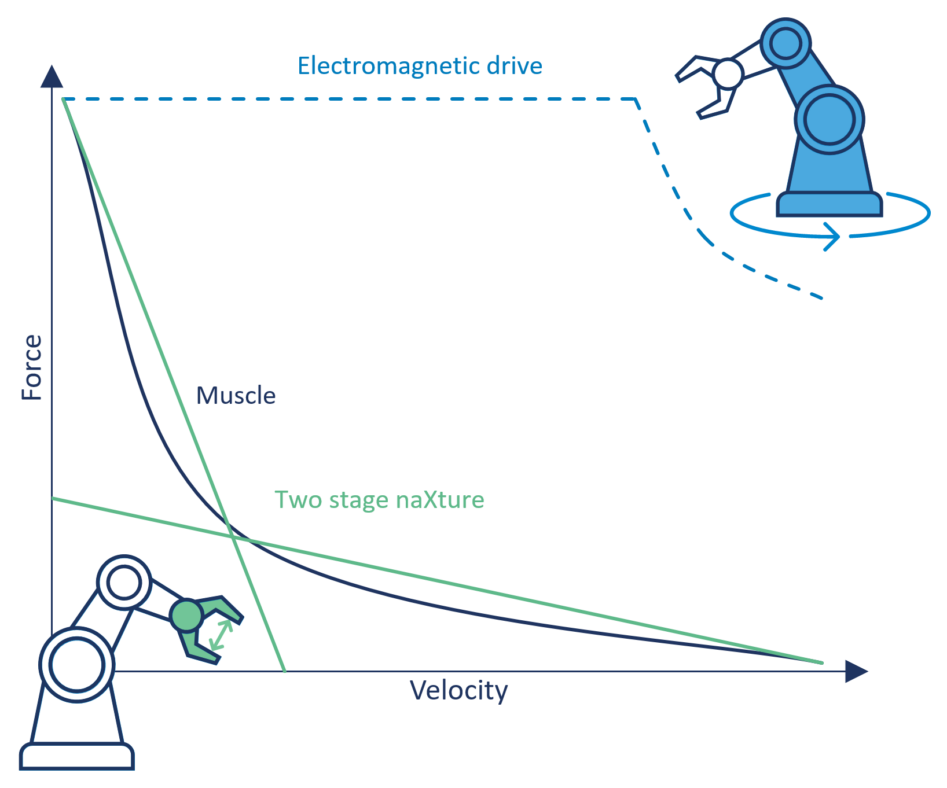
The foundation for this is a modular toolkit that allows systems to be designed according to the logic of electrical circuits: individually controllable pressure/flow sources are combined with fluidic components – such as transistors, diodes, or resistors – to achieve the specific function a customer requires. Based on this, actuators can be configured and, for example, operated as an agonist/antagonist pair, just as they are in the human body: when one actuator opens, the other yields passively, without requiring active control. When both actuators are driven simultaneously, targeted stiffening occurs; in the inactive state, impedance remains minimal – or precisely at the level needed to maintain a humanoid’s baseline posture.
Application Areas: Hand, Foot, and Spine
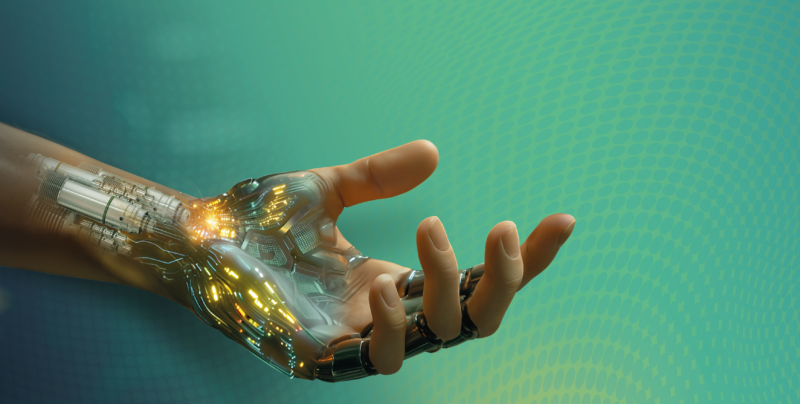
A particularly vivid example is the hand – a highly complex multi-actuator system where the use of our actuators is easy to envision. The requirements – high robustness, tactile sensitivity, and the efficient integration of multiple actuators in a single solution, all within a power budget of a few tens of watts – illustrate exactly why naXture could offer a promising answer here.
Similar requirements apply to foot actuation, where the calf and shin muscles in the human model likewise work together as an agonist/antagonist pair. Here, the priority is shock-resistant actuation with adjustable impedance.
A particularly promising and increasingly discussed application area is the humanoid spine. Integrated actuators can be built directly into scalable vertebra units – a highly integrated multi-actuator system enabling human-like movement patterns. This is an area where we see especially strong potential for our platform.
Conclusion
The question at the heart of the talk remains as relevant as ever: could piezohydraulic actuators truly drive the next generation of humanoid limbs? We are convinced they can. naXture is set to become a key element of humanoid robotics – from the industrial-grade, tactile hand to the shock-resistant foot to the precisely controllable spine.
As a partner to the robotics industry, we’re working to make these ambitious projects a reality together with our customers.
The hand, foot, and spine of tomorrow – made possible with naXture.
Got your interest ?
Then why not also take a look here!
- People Behind MetisMotion | Tomas Gisicius
- Piezohydraulic Actuators for the Next Generation of Humanoid Limbs
- People Behind MetisMotion | Shubhangini Awasthi

- People Behind MetisMotion | Admirim Sheholli

- Halftime in the EIC Accelerator – our midterm assessment

- Giving AI “the human touch” – MetisMotion @ automatica 2025

- naXture multi-actuator Solutions – Compact Power for Industry, Flexibility for the Future

- MetisMotion presents “Ultimate design flexibility for YOU!” with naXture @ automatica 2023

- MetisMotion – Join our SUCCESS STORY